Interoperability looks like a technical detail until an operation stalls for a non-technical reason. A team arrives with the right equipment, but has difficulties to fit in the host’s command structure. A second team has strong situational awareness, but cannot share a map layer. Radio traffic is constant, yet messages do not reach the people who need them.
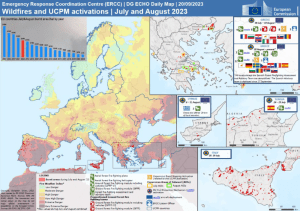
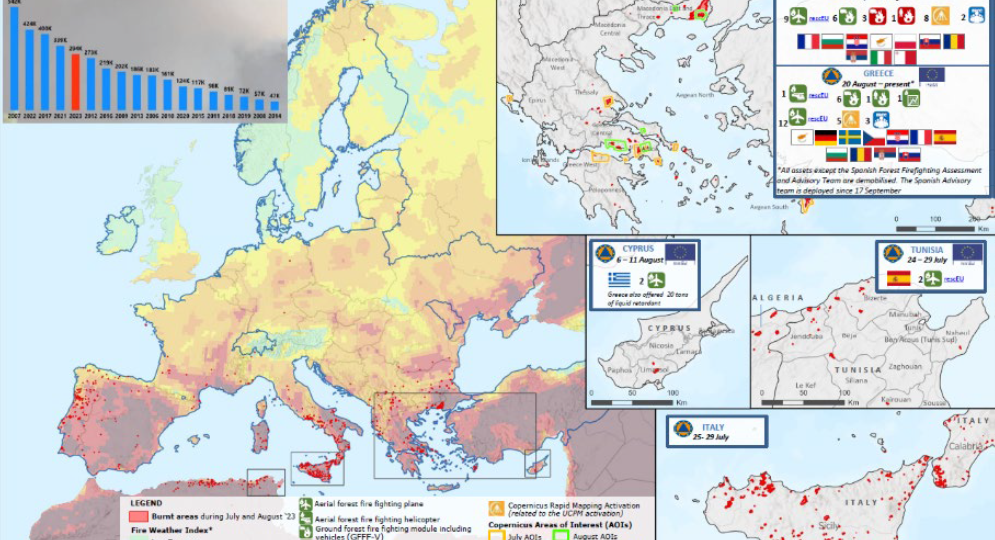
When wildfires swept through Greece in 2023, burning the largest area ever recorded by the European Forest Fire Information System, twelve countries rushed to help. Aircraft from Sweden, Croatia, and France joined ground teams from Bulgaria, Romania, and Slovakia. On paper, it was a textbook example of international cooperation. Behind the scenes, however, firefighters faced a less visible challenge: making their equipment, procedures, and expertise work together seamlessly.
This is the interoperability problem—and it’s far more critical than most people realize. DARE’s work on cross-border disaster response treats interoperability as a real-world capability, not a slogan: different organisations, often from different countries, can plug into each other’s way of working and deliver results under pressure.
Start with a simple definition
Interoperability is the ability to work together predictably.
That predictability comes from alignment in three places.
1) The technical layer
Systems can connect and exchange information. Data formats align, interfaces exist, networks and radios can talk, and tools remain usable in the field.
2) The procedural layer
Teams can operate through compatible methods. Standard operating procedures, reporting formats, tasking routines, and safety processes are close enough that cooperation does not require constant translation.
3) The human layer
People can coordinate. They share key terms, understand each other’s roles, trust the chain of communication, and have enough joint experience to make good decisions quickly.
If one layer is weak, the others do not compensate. A shared platform does not help when teams interpret terms differently. A common procedure does not help when communications fail. Interoperability breaks where alignment breaks.
How defence organisations frame it
In defence, interoperability is treated as the connective tissue of multinational forces. The focus is broad: doctrine, training, logistics, maintenance, and the digital systems that link them.
A useful contribution from the NATO world is the idea of levels of interoperability. “Working together” can mean basic compatibility, coordinated action, or fully integrated operations. This matters because it prevents vague planning. It forces a decision about the target state.
DARE also highlights a recurring weakness in this context: measurement. Even where interoperability is a long-standing priority, collecting observations in comparable formats and translating them into consistent improvements remains difficult. The result is uneven learning. Local solutions emerge, but they do not always add up to a shared picture.
The lesson for crisis response is straightforward. If interoperability cannot be assessed in a stable, comparable way, it stays a set of anecdotes.
How civil protection embeds it
International urban search and rescue provides a different route. INSARAG makes interoperability less dependent on improvisation by building it into the system.
Operational experience feeds into shared guidance. That guidance then becomes the basis for team development and classification. In practice, teams are not mainly judged on how smooth cooperation felt during a mission. They are assessed against whether they meet a baseline that makes cooperation predictable before deployment.
This is a standards-first logic. Instead of trying to coordinate away differences in the field, it reduces differences before they matter.
How national multi-agency systems make it practical
Within a country, interoperability is often designed for routine reality: several services arriving at the same incident and needing to operate as one.
Two approaches stand out in DARE’s scan.
- The U.S. Interoperability Continuum treats interoperability as a set of reinforcing conditions. Governance, procedures, technology, training/exercises, and day-to-day use rise or fall together. Buying equipment without governance and training produces only the appearance of interoperability.
- The UK’s JESIP approach is explicitly behavioural. It focuses on how agencies co-locate, communicate, coordinate, build a shared picture of risk, and maintain shared situational awareness. The point is to make cooperation repeatable through a common method.
These frameworks matter because they make the “human” and “procedural” layers visible and manageable, not assumed.
A Path Forward
The solution isn’t simple, but it’s clear: Europe needs harmonised approaches for depicting module capabilities, harmonised training programs, common operational vocabulary, particularly for those cases in which multiple countries are involved. Most importantly, it needs a systematic approach to documenting and implementing lessons learned—one that transforms individual experiences into strengthened collective capability and the evolvement of standards, following the example of the INSARAG community.
When disaster strikes, international cooperation isn’t optional—it’s essential. But sending help across borders isn’t enough. The question isn’t whether countries will respond, but whether their responses will work together when it matters most. Interoperability isn’t a technical detail; it’s the difference between effective crisis response and costly ad-hoc operations.
DARE will build on the examples above to develop interoperability assessments and to enhance the described layers in a strategic manner.
Fraunhofer contributes to these activities by reviewing past activations, by conceptualising and implementing different types of trials and workshops and by bridging the science-policy interface through strategic consultancy and the development of policy papers.
Find it here: Maps
Written by:
Dr. Claudia Berchtold, Coordinator – Sustainable Transformation and Risk Reduction and Dr. Sebastian Wagner, Senior Researcher – Data and Knowledge Management, Fraunhofer FKIE