
For the DARE project, one important way to understand how cross-border response actually works and to find out about lessons learned is to engage with experts involved in the activation of the Union Civil Protection Mechanism (UCPM) to. Because the real test for interoperability happens in the field, when teams from different countries arrive at an emergency scene and must work together under pressure. Interviews with experts allow us to reconstruct how decisions are made during a crisis, how international assistance is integrated, and where practical challenges appear. One such conversation with Lukas Czeszak focused on the activation of the EU Civil Protection Mechanism during severe flooding in northern Germany in 2023/24. The discussion provides an insight into how international assistance is requested, coordinated, and integrated into an integrated response system involving multiple levels of governance.
When national resources reach their limits
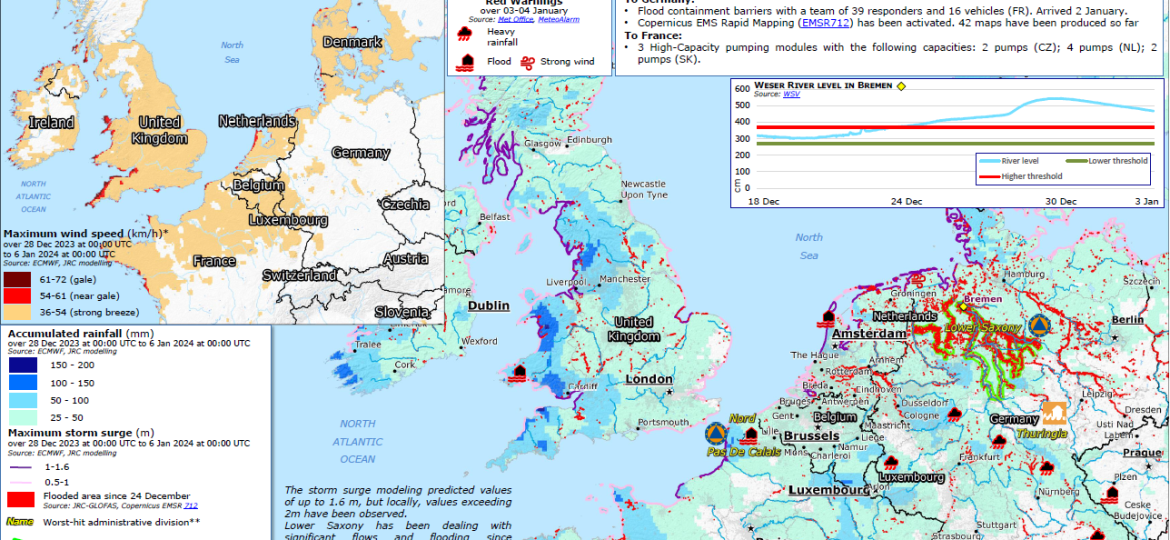
The flooding situation in the winter of 2023/24 developed after a prolonged period of rainfall. The local authorities deployed all available resources, including large quantities of sandbags and mobile flood protection systems. Initially, additional support was requested from other German federal states. But at a certain point, no further mobile flood containment systems were available nationally. With the situation still evolving, authorities decided to request international assistance through the UCPM. The request asked for a mobile flood containment system at least one meter high and roughly 500 meters long. In addition, the Copernicus Emergency Management System was also activated for the delineation of the flooded areas and further analysis. Within the European system, this request triggered several offers from different countries. Based on the availability and geographical proximity, a French flood containment module was selected and quickly deployed to Germany.
Once the French team arrived, their operational professionalism quickly became evident. According to Lukas Czeszak, the team worked very independently and required little technical assistance. They arrived with their own equipment, including capabilities such as drones that allowed them to assess terrain and plan their deployment. In practice, however, international deployments are rarely just about equipment and technical capability. Integration into the host country’s operational structures is just as important. This is where Host Nation Support (HNS) becomes critical. In this case, the host authorities were able to provide extensive support, including accommodation, logistics, liaison personnel, and interpreters. Two liaison officers accompanied the French team to ensure communication with local structures, while interpreters helped resolve technical terminology when necessary. This arrangement proved highly effective. The international team could focus entirely on its operational task, while the host side managed coordination and logistical issues.
The importance of context and coordination
One key lesson from the operation was the importance of explaining local command structures to incoming international teams. Emergency management structures differ significantly between countries. In Germany, for example, operational responsibility lies at the municipal and regional levels rather than at a central authority. For international teams arriving in such a system, understanding who has decision-making authority is essential. Initial briefings and regular situation meetings played an important role here. They ensured that the international team understood the operational context and could coordinate smoothly with local responders. However, the level of direct operational integration remained relatively limited in this case. The French module worked largely on a single assigned site, installing a mobile flood protection system to reinforce a potentially vulnerable dike section. This meant there were relatively few operational overlaps with local firefighting units. While this simplified coordination, it also that the more deeply teams must integrate into each other’s operations, the more complex coordination becomes.
Operational insights: equipment and capabilities
The interview also revealed practical differences in how countries approach flood protection capabilities. The French module deployed water-filled barrier systems. German authorities, by contrast, have recently procured different types of mobile flood protection systems, including angle-support barriers. These systems are not necessarily compatible with each other as there is a diversity of equipment available on the market. Czeszak explained that from an interoperability perspective, this diversity does not automatically create problems. As long as each system can function independently, solutions can be found to install connections in between them. Especially since the range of the modules is rather wide. Therefore, compatibility between systems is possibly less critical. What matters more is understanding what a system can and cannot do. More detailed capability descriptions could help improve decision-making when selecting offers of international assistance.
The effort behind Host Nation Support
Another key takeaway from the interview is the resource intensity of Host Nation Support. Providing accommodation, logistics, liaison personnel, communication support, and coordination requires significant planning and personnel. In this case, the effort was manageable partly because training facilities were temporarily unused during the holiday period and could be repurposed to host the incoming team. Such conditions cannot always be assumed. For future responses, this raises an important question: how can host nation support capabilities be distributed more widely and effectively across regional and local authorities so that international assistance can be integrated smoothly even during large-scale or prolonged crises? For the effective integration of international assistance into Germany’s civil protection system as well as the efficient transit of capacities, a reliable Host Nation Support (HNS) system is therefore fundamental and steps toward nation-wide standards, procedures and services have recently been initiated with the EU-funded project “HNS BridGER” – Bridging Legal Frameworks and Practical Readiness in Host Nation Support.
Why operational experience matters
For the DARE project, interviews like this are essential as they provide practical insight into how international cooperation actually unfolds during emergencies. Formal standards and operational guidelines remain essential. But the on-side experience of disaster response such as communication structures, logistical coordination, equipment differences, and decision-making under uncertainty, are often best understood through those directly involved. This knowledge will contribute to improving interoperability across European civil protection systems and ensuring that international assistance can be integrated quickly and effectively when it is needed most.
Written by: Jule Weippert, Bundesamt für Bevölkerungsschutz und Katastrophenhilfe (BBK).
